13 October 2011

Oktoberfesting

It's getting to be that time of year again: autumn, or as I like to call it, the Month of Gratuitous Oktoberfesting. It seems like, as soon as October starts, everything here starts to have Oktoberfest themed celebrations, which, if nothing else, does accurately reflect the high German population in the Upper Midwest. This is all well and good, provided said Oktoberfests actually understand what Oktoberfest is outside of it being German.

By this, I mean that I get annoyed when a place (read: the dining hall) puts on an Oktoberfest with the only Oktoberfesty aspect of it being that there are brats. If you don't give me beer, I do not accept your validity as an Oktoberfest.

Oktoberfest is a Bavarian beer festival, that happens to include lots of traditional Bavarian foods such as bratwurst and schnitzel because you can't survive on beer alone for two plus weeks. (Actually, given the high caloric content of beer, you might be able to, but even if you could, you probably shouldn't.)

I know that some of you, imaginary readers, are currently shaking your non-real heads are telling me that no, it is a celebration of German culture, so I should stop complaining about it being accurately portrayed in America. But to that I say, you are right, it is a celebration of German culture, but a full fifty percent of German culture, particularly in Bavaria revolves around beer (the other half consists of discipline and not talking about anything that happened between 1933 and 1945).

And yes, I know that I'm not an expert on German culture because I'm not German, but I did survive four years of [Frau Crazy]'s German class, so that has to count for something.

I generally don't think things need to be authentic to their origins, as I don't care that you're Oktoberfest celebration is a weekend in mid to late October rather than 16 to 18 days at the end of September through the first weekend in October. That doesn't matter to me. What matters to me is that you at least try to understand what it is that you are emulating and stay true to  the concept. Oktoberfest is a beer festival. If you're not going to have beer, call it something else. This is all.

10 October 2011

Theory of Gendered Digestion

For my GWSS class today, we had to read a chapter from Elizabeth Wilson's book Psychosomatic: Feminism and the Neurological Body about the links between the Central Nervous System (CNS) and the Enteric Nervous System (ENS), which is made up of all of the nerves in your gut and regulates everything between the stomach and the rectum, and is often referred to as the "brain in the gut" or "second brain" because of how closely it resembles the CNS.

The article was more scientific than theoretical, and dealt with the relationship between ENS and CNS, specifically which one is more in charge when it comes to how out gut feels, and which way the feedback loop runs. I thought it was fairly interesting, if for no other reason than it included some really interesting facts about the ENS, including that we have more neurons in our gut than our spinal cord, and that the neurons in the ENS are more similar in structure to the CNS neurons than the those in the rest of the peripheral nervous system.

The article was interesting in it's own right, but it was also a fairly big departure from what we have been reading, given that it is an example of feminist science practice rather than feminist science theory (which kills me, because science is science, dammit, but academic feminists don't seem to like that line of reasoning). The feminist theory was implied in how Wilson approached the relationship between the ENS and CNS, saying that there wasn't a hard and fast division between the two, rather than explicitly stated, which threw some members of the class for a loop.

Prior to class starting, I overheard a couple of other students discussing the text. One of them was saying that she couldn't really see where the feminism came into play, and the other was telling her basically what I just told you, imaginary readers, to which she responded "I guess it has to do with the stomach being so closely associated with women." And the other student agreed with her.

What?

Since when has the stomach been associated with women? I can buy into some of the stuff we've read about women being associated with nature and sexuality and blah blah blah, but with digestion? I was under the impression that neither gender is more or less associated with that particular bodily function. I should say that this was a student speculating before class, and not anything the instructor said or that was stated in the text, but still. Is this actually a thing that I've just never encountered before? Or does this seem as crazy to you, imaginary readers, as it does to me?

09 October 2011

Friends of Friends

I ran into [Quiet Raver] the other day. She was tabling a vegan bake sale at Coffman when I was there with [Princess Leia Vampire] to exchange comics. It was more than a little bit awkward because, while we both go to the U, I've only seen her one other time since we started college. Part of me thinks that that's a shame, because we used to be somewhat close, and she was the first friend I made when we started high school. But, the truth is, I haven't stayed in touch with anyone from high school, nor do I particularly care to.

I didn't dislike high school. Despite the required religion classes and semi-regular mass, it was a good environment for me, and I think I got a lot out of it, both socially and academically. All that said, I didn't really have friends in high school. Don't get me wrong, I wasn't socially isolated or anything. I had people I ate lunch with, and who I hung out with before school, and who I talked to in class, etc. It was just that all of those relationships ended as soon as we weren't at school. I would hang out with them during the school day, and then after school and on weekends and during breaks they would hang out together and I was never invited.

I was only ever invited when it was a big group thing, like a birthday party or something like that, but, in a way, that only made it worse. It wasn't like they just didn't think to ask me to do stuff with them, they just didn't want to. They were never mean, and it wasn't like they didn't want me around, but I wasn't truly part of the group.

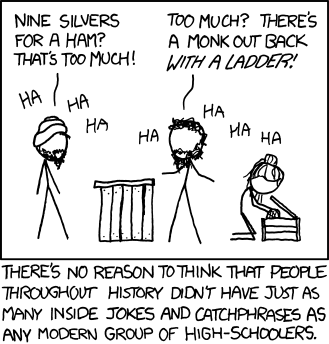
XKCD

The thing is, I can't just blame them, because it was probably, at least partially, my fault. They probably never knew how hard it was for me to listen to their inside jokes that I wasn't privy to, or how much it would have meant to me if they would have included me, but I wasn't going to tell them. Maybe if I had been more forward about what I wanted with them, I could have been more included, or at least realized earlier that I was wasting my time.

For a long time it didn't really bother me; I was okay with the way things were, because while things weren't great, they were good enough, which was all I really cared about. It didn't start to really bother me until senior year, when I finally realized what I was missing, but by then it was too late to really change things or get new friends.

I was bitter about it for a while, especially when I'd see pictures on Facebook of their escapades, and I was angry, both at them and at myself. But then, this summer I went to an end of the summer party at [Only Likes Asians]'s, and I saw them again, along with a bunch of other people. And while I talked to them for a while, which was super awkward because they were the same as ever, I spent a lot more time talking to other people from high school, who I was never super close to. I realized that [Operant Conditioning] and [Daphnis] and [Techie At Heart] et al. will probably be best friends for a long time and stay in touch for a while, and I don't have a place in that, but I also realized that I was okay with that.

Maybe it's because I finally realized that we were never very good friends to begin with, and maybe it's because I realized that we didn't really have much in common to begin with, but I think it was mostly because I didn't need to be friends with them anymore because I have a close group of friends now, that I'm actually friends with. In a lot of ways, this is the first time in my life that I've felt completely part of a group, rather than on the periphery, and it's made me realize both what I missed in high school, but also that I'm fine with that. Like I said, there was a lot of high school that I enjoyed, and a lot of things that I wouldn't change, it's just that since I started college, I've realized what it could have been, what I could have made it, but that's hindsight I guess...

06 October 2011

In Defense of the Oxford Comma

This is why the oxford comma (or serial comma) is an important part of the English language, disregarding the fact that it is my  favorite punctuation mark.

I wasn't able to find where this image originated, but kudos to whoever made it.

This image makes both my inner history nerd and my inner grammar nerd incredibly happy. That probably says a lot about me, but whatever...

05 October 2011

Comic Book Wednesday: Anatomy Lessons

I have a poster on my wall that shows a collection of female Marvel comics characters, which I like because I am generally a fan of both Marvel comics and female comic book characters, so it's a win in every dimension. On multiple occasions now, when people who aren't comic book nerds have seen it for the first time they've asked me why all the the female character have such large breasts, to which I don't really have a good answer other than that they're comic book characters.

In truth, I don't really think about the proportionality of comic book characters anymore, probably because I'm so familiar with the genre that I don't think about things like that anymore. I understand that some people are offended by the fact that nearly every single female character in mainstream American comics is a double D with a 15 inch waist, because I do get that women aren't portrayed in a realistic manner, which can contribute to body issues in impressionable girls. I mean, Power Girl is just ridiculous and I wish Emma Frost wore more clothing, but I find that the people who complain about them are missing something fundamental because they are ignoring what comic books are.

Power Girl: Superman's cousin from an alternate timeline which no longer exists, maybe.
Just looking at Emma Frost makes me cold. This is not a practical outfit.
Comics are entertainment, and, ultimately, escapism. I don't read comics to better understand the world I live in. I read comics because I enjoy the world of the comics. They aren't portraying real people, nor are they claiming to portray real people, so holding them to a standard that is defined by what is real is dumb. I would contend that people don't read comics to see themselves reflected in the characters. They read comics to see scantily clad women and ridiculously buff men with superpowers fight it out for 22 pages. Also, sometimes the stories are good too.

Secondly, comics are a genre written by and for men, nearly exclusively. The fact is, there are very few women who read mainstream American comics, so comic creators shouldn't be expected to write/draw things that appeal to sensitive women's sensibilities because they make up such a small portion of the audience. Comics are a struggling industry to begin with, and if they were to risk alienating a major part of their audience (who are very easily offended to begin with, just look at the hullabaloo over giving Wonder Woman pants) just to satisfy a really small group of people who aren't buying comics anyways it would be really bad for business. And, ultimately, it is a business. It exists to make money by selling comics not to promote good body image in girls.

Thirdly, men are equally as ridiculously proportioned as women in comics, a fact that people tend to ignore. It is routine for male characters to have the musculature of a 'roided out body builder who is half giant. The 90s were particularly bad for this.

His forearms are larger than a baby. Think about that for a moment.
 This can't be good for the body image of your typically teenage nerd who reads comics. But no one wants to talk about that.

Ultimately, I just think that comics are comics, and that as a genre, like everything else, they have their problems, but, in the grand scheme of the depiction of women in comics, cup size is really the last thing people should be worried about. In a genre where female characters are regularly used solely as a plot device for the male character (see Women in Refrigerators), and where female characters have fewer solo titles and team titles than men, and where it was a huge controversy among fans to put pants on Wonder Woman, I think that there are better things to try and change.

I may not be the best judge of these things, but as a comics fan, and as a woman, I don't think people are making a big deal out of the right issues. Realistic anatomy is never going to happen in comics, in no small part due to the stylization of the art, but depictions of female characters as believable people can and does happen, maybe not often enough, but it does, so that's where I think people should focus their efforts. I think it may be more important for Wonder Woman to be able to wear pants than for her to be realistically proportioned, but that's just me. 

04 October 2011

Attack of the Midterm Monster

Midterms start this week for me, which of course means that I'm blogging about them instead of studying for them, but it's only Tuesday, and I don't have any tests until Friday. To illustrate my feelings about midterms, or any exam really, I have made another graph for you, imaginary readers. It compares my preparedness for midterms to my anxiety about midterms.


With colors and everything.

Exams generally don't bother me that much, but I have two this Friday, both of which require me to actually study, and I hate studying for math tests. Cell bio just requires that we know everything there is to know about everything our Professor has lectured on, and calc requires me to be able to do actually complicated procedures that I should probably learn sometime this week.

What I don't like about midterms is less of the studying/test taking part, and more that once midterms start, they don't end until finals. The way my college structures exams, each class usually ends up having three midterms, with some classes having four, and they never seem to overlap particularly well, which means no really bad weeks, but also means having a test every week or two for the entirety of the semester. Or at least, that's how it was last year, and it looks like it is going to follow the same pattern this semester.

I tend to view tests in a very adversarial way. Exams are like battles. Victory necessitates preparation and strategy, but, ultimately a complex series of factors determine the victor. Sometimes, for whatever reason, the exam wins the day, but I have a pretty solid victory percentage.

Different classes have exams that resemble different battles/campaigns. For example, Physics tests late year were usually Pyrrhic victories, so I was Epirus and the class was Greece, whereas O Chem was the Fourth Crusade (my favorite Crusade) and I was the Crusaders, laying siege to and ultimately sacking Constantinople (the exams).

I guess one could say that I'm at war with my education, which is a little bit harsh, because I like being in school, and will probably be in school for a very long time, I just don't particularly enjoy midterms and the stress they come coupled with. I was quite enjoying this past month of being back at school but not having any exams, which I won't get again until January (although the first month of Spring Semester wasn't nearly as calm as September was last year, so I don't know if that's how it's going to be again this year). But that's over now, and I have to find some way to motivate myself to study, but that's what being in school is: a never ending series of exams coupled with a severe lack of motivation to study for said exams. Or maybe that's just me...

02 October 2011

If Science Were Horses We'd All Be Confused

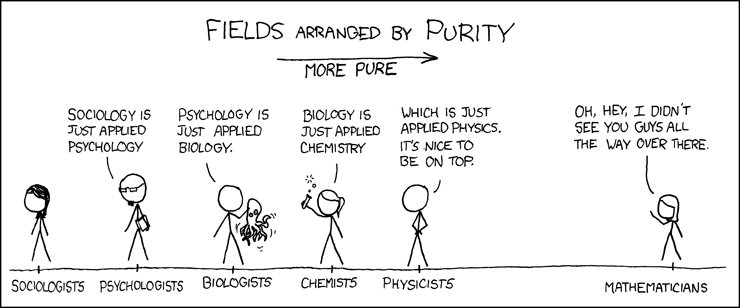
I'm taking a Gender Women's Sexuality Studies (GWSS) class this semester, which focuses on science studies and feminist theories of science. Two things that I didn't know existed until a month ago, and I sort of wish I was still ignorant of. So far, everything we've read and discussed in class has been focused on criticizing the current practice of science, which is fine, nothing is above criticism, but the singular focus of the material on science as a monolithic, patriarchal institution that is bent on the oppression of everyone who is not a white male does bother me. It just seems so academic; divorced from the actual practice of science, written by people who spend their days coming up with problems that don't necessarily exist to justify their existence as a field. Kind of like mathematicians.

This is probably an overly harsh sentiment, and I am biased towards science, but the way that these writers talk about science really bothers me. They discuss it as if it were an over arching institution of Science with a capital "S." As if it were one singular thing that can be quantified and discussed. This just isn't true.
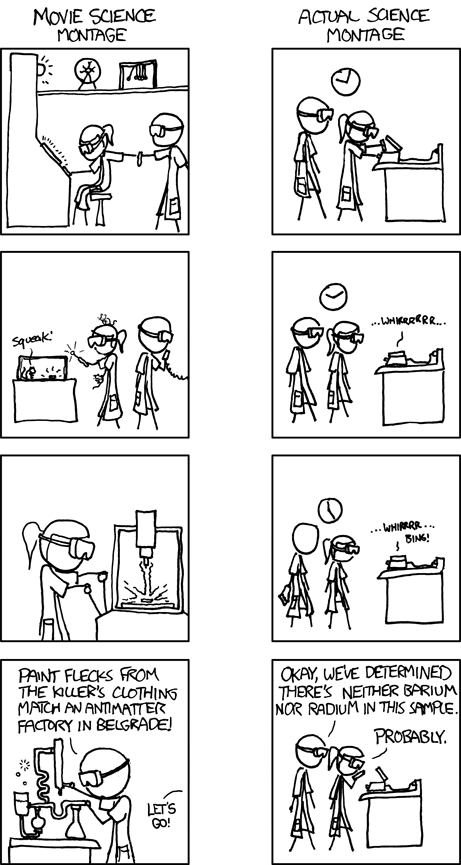
XKCD

Science isn't a singular thing. It isn't a uniform institution for the discovery of the Truth About the Universe, or even a single way of looking at the world. At its core, science is just a tool: a process that can be employed to help us make sense of the world around us. No single person or theory or institution can accurately represent science, because, ultimately, science is just a concept, a method.

Science is in the experiment, in the questions we ask about how our world works, and in the data that we collect about it. What we make of those results is about us, and our knowledge and world view, not about the science of it. This is where the critics we have been reading have a point. The place we come at the data from does influence how we interpret it, but we are human after all, and it is unfair to blame science itself for the inevitability of human nature. People can be racist and sexist and homophobic, and thus they way they interpret their data can be all of those things, but that's not the fault of the method, that's the fault of the person.

You wouldn't say that someone once wrote a racist novel, therefore the way in which novels are written must be inherently racist and needs to change. That doesn't make sense. But that's what feminist science studies is saying in many respects. Science has been used to justify sexism, therefore science is inherently flawed. That doesn't mean anything, really. It doesn't do anything to advance the feminist cause to yell at science to change, when really you should be yelling at the people who practice science and the people who misinterpret science to change.

Intersectionality is really important in a lot of the feminist theory we've been reading. It is basically the idea that people are composed of a bunch of different identities and we need to acknowledge all of them to really understand where a person is coming from (which I think is kind of obvious, but I'll let them have that.) The overwhelming opinion of the class is that science would be better off if it took a more intersectional approach, because it would better equip science to find the truth. I'm sorry, but what? I can understand that you're a black woman with an interest in slow jazz and Asian culture, but that doesn't change gravity, or photosynthesis, or the equilibrium constant of an acid-base reaction. Science is the interpretation and understanding of how the world works, and the world works based on a finite set of physical and chemical laws and principles, not on you're identity, no matter how complex it may be. If, when you are analyzing scientific data, you are thinking about your intersecting identities, YOU ARE DOING IT WRONG. (Granted, this doesn't apply to the social sciences, but, as important and valid as those fields are, I don't personally consider them science).

Yes, the institutional practice of science has its flaws. It is definitely very male dominated, and it can be hard to break into and understand as an outsider. It is slow to change, and often, there are no clear results due to ambiguity in the data and conflicting evidence. Politics also plays an important role is what is funded and what is enshrined as law. But those are problems with the practice of science, not with science itself. Nothing is perfect, and science has its problems and issues and controversies like every other field, but I don't agree with the characterization of it as a single oppressive unit, particularly since that characterization tends to be based solely on examples taken from the biological sciences, which aren't representative of even institutional science as a whole.

Biology is inherently one of the most subjective fields within the natural sciences because the systems are so far removed from the first principles, which necessitates more subjective interpretations, which are more open to the influences of one's own philosophies. To only look at biology and then to draw conclusions about the way science is practiced as a whole, is even more flawed than just trying to make broad generalizations. It displays a fundamental lack of understanding about the fields being criticized.
XKCD again

All of this isn't to say that I'm against feminism, which I'm not, I just have a problem with some of the theory. Writing about your problems with science is not going to change anything, particularly since the only people reading feminist theory are other feminist theorists. If you want to actually change things, stop pandering to your academic peers, and start going out and doing things. Science doesn't oppress people; people oppress people, and theorizing about that oppression doesn't stop it. Also, if you are going to theorize about something, try and start by having a basic understanding about what you are talking about.

For the sake of sourcing what I'm ranting about, here are some of the authors who I'm referencing:
Carolyn Merchant, Evelyn Fox Keller, Barbara Ehrenreich, Deirdre English, Emily Martin, Nancy Tuana, Lisa Weasel, Siobhan Somerville, Banu Subramanium, and other.